Stop Paying for More Chargers for your EV Fleet. Get it a Brain Instead.
As electric fleets scale, charging them efficiently becomes a sequential, stochastic optimisation problem that static heuristics can't solve. Here's why reinforcement learning is the answer.
The era of electric fleets is here. From delivery vans and ride-hailing networks to municipal buses and logistics fleets, electrification is accelerating rapidly, driven by carbon goals, regulatory pressure, and long-term cost advantages. Yet for operators managing hundreds or thousands of vehicles, charging them efficiently at scale poses a formidable challenge.
A fleet is not just a group of vehicles; it is a large, flexible load on the electrical grid. Traditional charging strategies struggle with demand spikes, dynamic electricity pricing, costly grid penalties, and stringent service-level obligations. To meet these constraints while minimising operating costs and maximising readiness, fleets need adaptive, real-time decision-making systems, and that's where reinforcement learning (RL) shines.
The Charging Challenge: Layers of Complexity
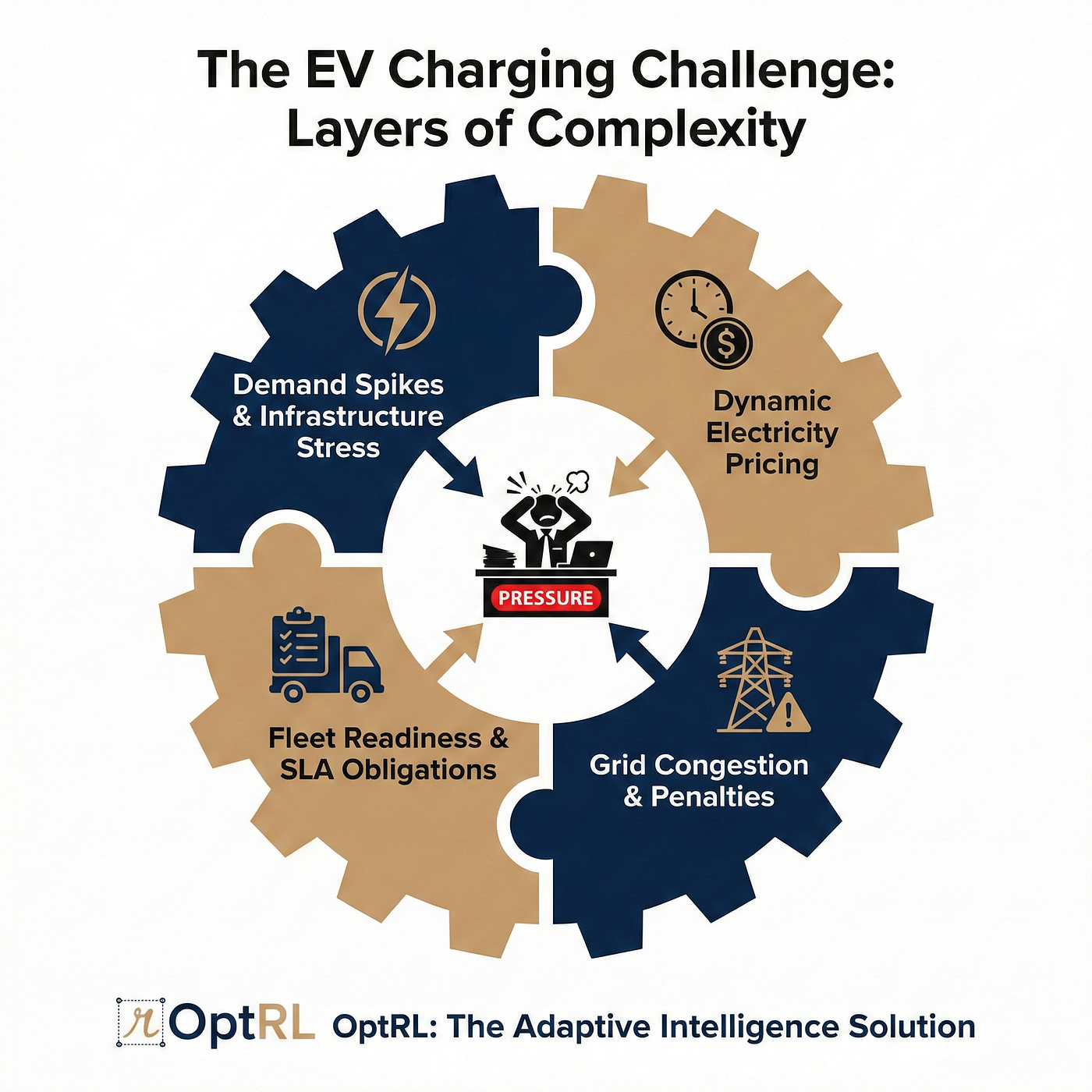
Fleet leaders face multiple, interlinked constraints, including, but not limited to:
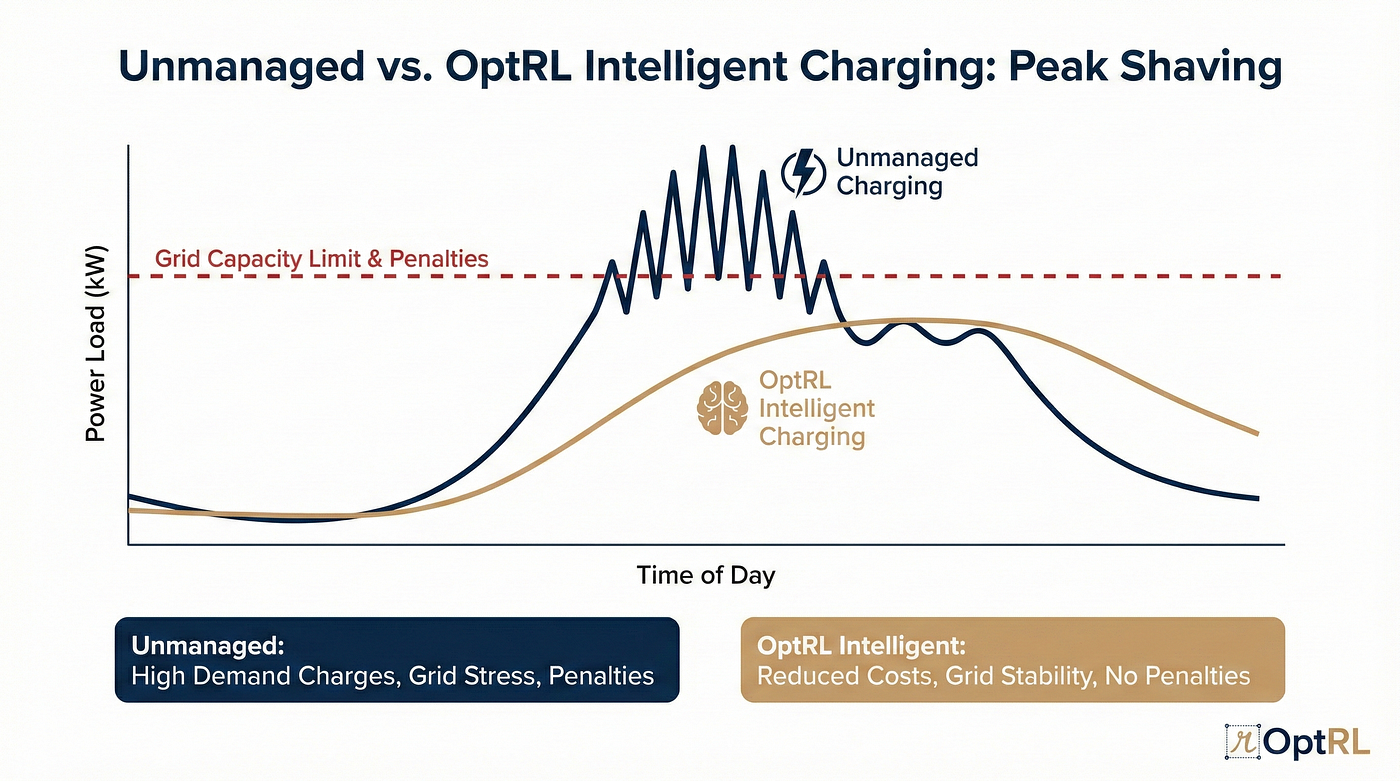
Demand Spikes and Infrastructure Stress Uncoordinated charging, where all vehicles charge at maximum power whenever plugged in, can create sharp peaks that strain local distribution systems. Studies of unmanaged EV charging show sudden, high-load peaks (e.g., 114 kW) from simultaneous charging events, whereas optimised charging systems produce smoother, lower peaks. Such spikes force utilities and fleet operators to either pay expensive demand charges or invest in grid upgrades that may sit idle most of the time. According to research, smart charging strategies can reduce grid reinforcement costs by up to 50% in European cities and up to 70% in U.S. utility service areas compared with unmanaged charging.
Dynamic Electricity Pricing Electricity costs are no longer flat. In many markets, time-of-use and real-time pricing vary throughout the day based on system demand and renewables generation. A landmark U.S. Department of Energy report found that smart charging can reduce the effective electricity cost for EV charging to about 75% of the annual average electricity price by shifting load away from peak hours. This opens a significant opportunity: fleets that intelligently align charging with low-price windows can substantially reduce energy spend, and it's not just theoretical. Studies show that smart charging can reduce total charging costs by roughly 20–30% compared with unmanaged charging strategies.
Grid Congestion and Peak Load Penalties High peak-load periods lead to demand charges, which on commercial electricity bills can account for 30–70% of the total cost. Smoothing load profiles reduces both these penalties and the need for costly infrastructure upgrades, a multibillion-dollar concern as fleets and EV adoption grow.
Fleet Readiness and SLA Obligations Unlike private cars, fleets must meet strict availability targets. Delivery schedules, bus routes, and mobility platform commitments depend on vehicles being charged on time, every time. Static scheduling or heuristic approaches can leave vehicles undercharged or misaligned with operational needs, eroding reliability.
The Brain Upgrade: Ditching Dumb Heuristics for Adaptive Intelligence
With all these caveats and complexities, charging an EV fleet is not a scheduling spreadsheet problem; it is a sequential, stochastic, constrained optimisation problem. Every charging decision affects future flexibility. For example, charging aggressively at 6 PM may satisfy today's departures, but it will eliminate flexibility for cheaper overnight pricing. Waiting too long may risk SLA violations.
This is precisely the type of environment where static rules fail.
Heuristic strategies, such as "charge after midnight" or "charge when below 40%," do not generalise across seasons, depots, or tariff structures. Traditional optimisation approaches often assume perfect foresight or require simplifications that collapse under real-world variability.
Furthermore, when this leads to fleets encountering congestion at depots, the instinctive response is "Add more chargers." But more hardware does not solve coordination.
If unmanaged behaviour continues, additional chargers may simply push the peak load even higher. In fact, greater simultaneous charging capacity can worsen demand charges unless intelligently controlled.
The smarter question is: "How do we orchestrate the chargers we already have?" This is where reinforcement learning transforms charging infrastructure from passive hardware into an adaptive control system.
At OptRL, we reframe charging automation as a dynamic, multi-objective decision system. Instead of following brittle schedules, an RL agent continuously calculates the optimal trade-offs between energy costs, grid limits, and vehicle departure SLAs. It learns from fresh feedback loops in real-time, functioning as the "brain" of your depot.
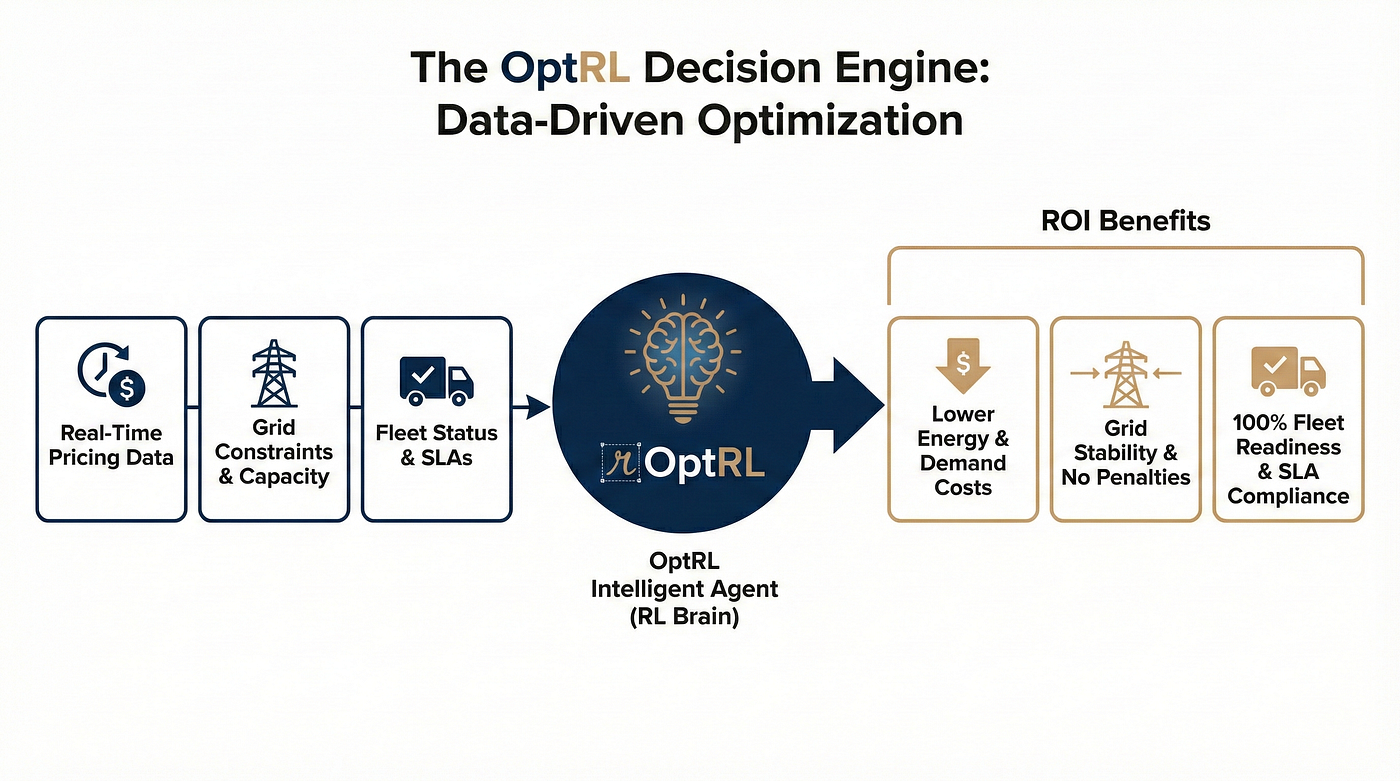
The ROI of RL: Shifting Fleets from Cost Centres to Margin Drivers
BloombergNEF projects that by 2030, more than 30% of new commercial vehicle sales globally will be electric, translating into millions of fleet vehicles that will require coordinated charging. The economic stakes of this transition are substantial. As fleets scale, energy effectively becomes the new fuel cost, which McKinsey estimates can represent 20–40% of total operating expenses for electric fleets. Transitioning to an intelligent, RL-driven operation is crucial to shift these EV fleets from a capital-heavy burden to a highly optimised margin driver.
One of the most significant financial drains on a depot comes from unmanaged demand charges, which can add thousands of dollars per month and often make up nearly 90% of a fast-charging station's electric bill. By deploying reinforcement learning, operators can perform real-time peak shaving. The National Renewable Energy Laboratory (NREL) has demonstrated that managed charging significantly reduces these peak loads, directly lowering both upfront infrastructure needs and ongoing demand costs.
Beyond avoiding penalties, the overall scale of savings is undeniable. Studies across U.S. utilities, consistent with Department of Energy findings, show that smart charging can reduce total charging costs by 20–30%. For an average commercial fleet of 500 vehicles, even a conservative 20% reduction in charging costs can translate into hundreds of thousands of dollars in annual savings, depending heavily on the specific duty cycles and local tariff structures.
The Sandbox Advantage: Stress-Testing Without the Risk
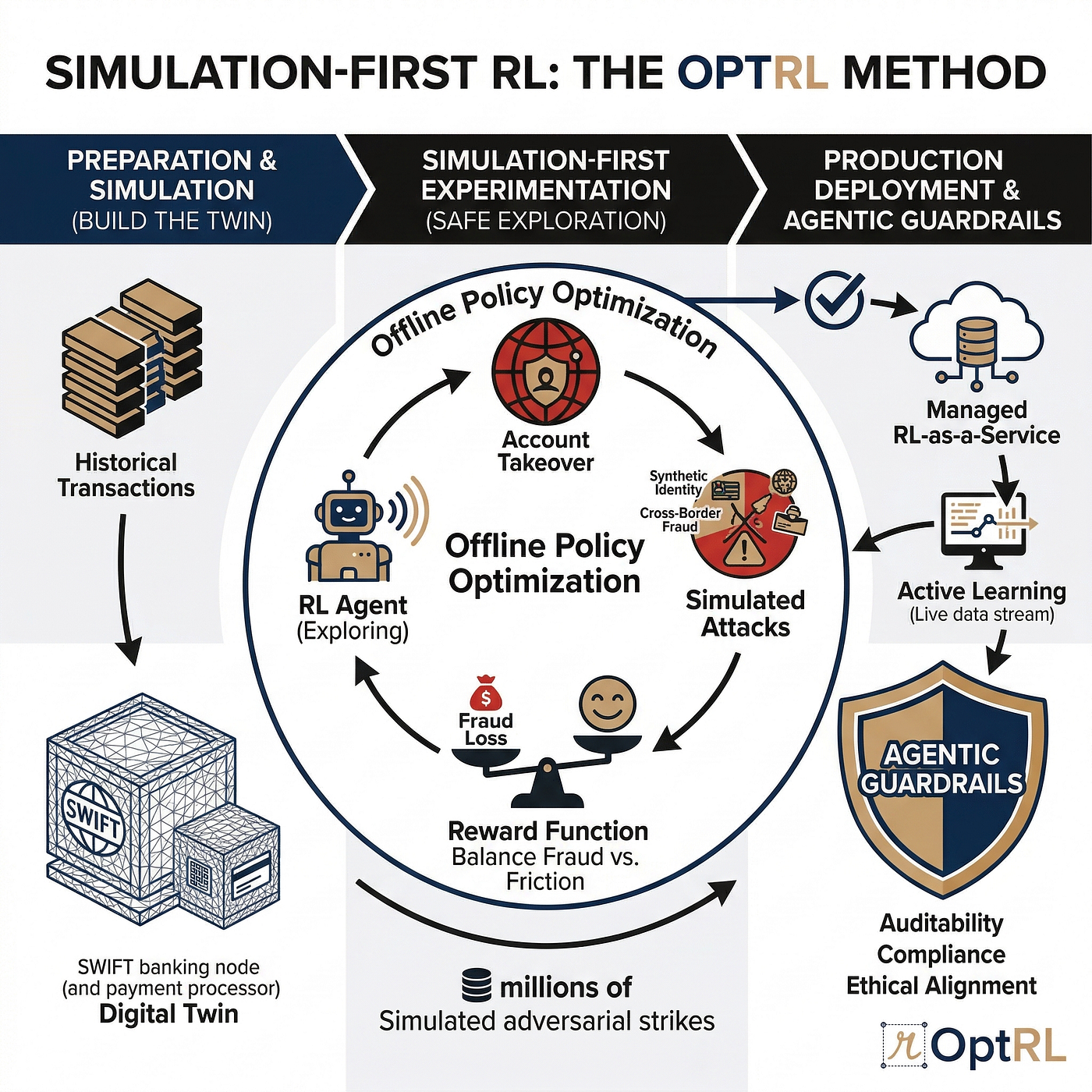
Enterprise fleets cannot afford to test algorithms on live delivery vehicles. OptRL tackles this through Simulation-First Experimentation. We build a tailored synthetic environment, a digital twin of your specific depot, grid constraints, and fleet schedules. Here, the RL agent safely explores millions of edge cases, learning to navigate rate spikes and delayed arrivals before a single line of code touches your operations.
Furthermore, our deployments are protected by strict Agentic Guardrails. This ensures that while the system aggressively hunts for cost savings, it will never violate core safety parameters or miss a critical delivery dispatch time.
Stop Buying Hardware. Start Deploying Intelligence.
Your fleet doesn't need more expensive chargers; it needs a system that knows when and how to act. By bridging the gap between cutting-edge AI research and enterprise deployment, OptRL delivers intelligent decision systems that improve with every charging cycle.
Connect with the OptRL team to discuss how adaptive intelligence can transform your fleet from a static hardware constraint into a continuously learning operational advantage. Book a discovery call today to define your KPI targets and explore a pilot rollout.
References
- https://www.nature.com/articles/s41598-025-88758-y
- https://smartgrid.ieee.org/bulletins/june-2023/accommodating-charging-load-due-to-high-electric-vehicle-adoption-and-tackling-grid-impacts-grid-reinforcement-vs-smart-charging
- https://docs.nlr.gov/docs/fy16osti/66121.pdf
- https://about.bnef.com/insights/clean-transport/electric-vehicle-outlook/
- https://www.mckinsey.com/capabilities/sustainability/our-insights/charging-electric-vehicle-fleets-how-to-seize-the-emerging-opportunity
- https://www.frontiersin.org/journals/artificial-intelligence/articles/10.3389/frai.2025.1700664/full
References:
Written by
OptRL