Fraud Detection Isn't a Classification Problem
Why treating fraud as a binary yes-or-no is costing enterprises billions in lost revenue and customer trust, and why adaptive agents are the only way to win.
Why treating fraud as a binary "yes or no" is costing enterprises billions in lost revenue and customer trust, and why adaptive agents are the only way to win.
The global payments industry is winning a battle while losing the war.
Payment card fraud losses totalled $33.41 billion in 2024, according to the Nilson Report. That is a number that moves risk committees and triggers vendor spending cycles. But there is a second number that rarely makes the board meeting.
It is nine times larger.
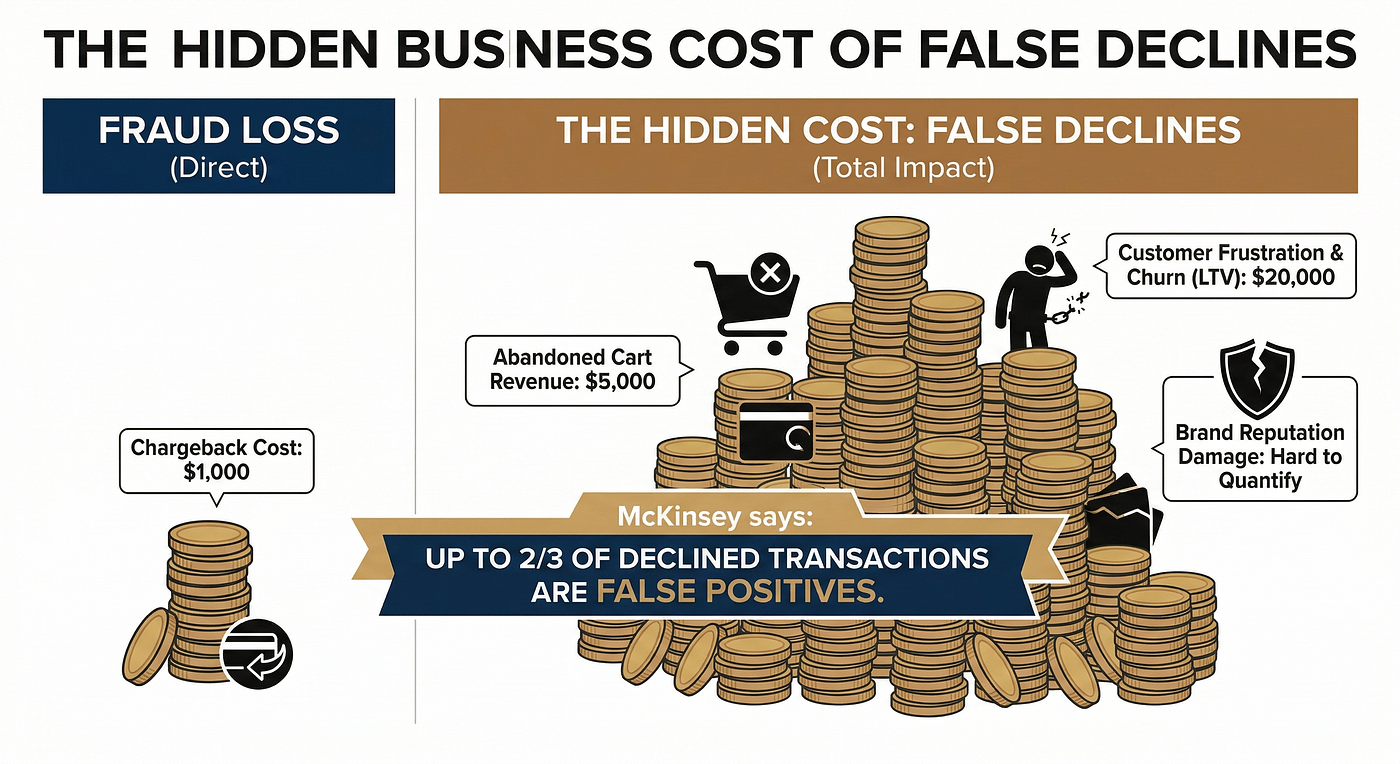
False declines and legitimate transactions blocked by overly blunt fraud systems cost merchants an estimated $443 billion globally every year, according to research by Riskified and ClearSale. In the US alone, that figure is $157 billion annually. Enterprises are losing $13 in legitimate revenue for every $1 of fraud they stop.
The industry's instinct is to tighten the net when fraud rises. The data shows that instinct is wrong.
Data Is Not the Problem. Decision-Making Is.
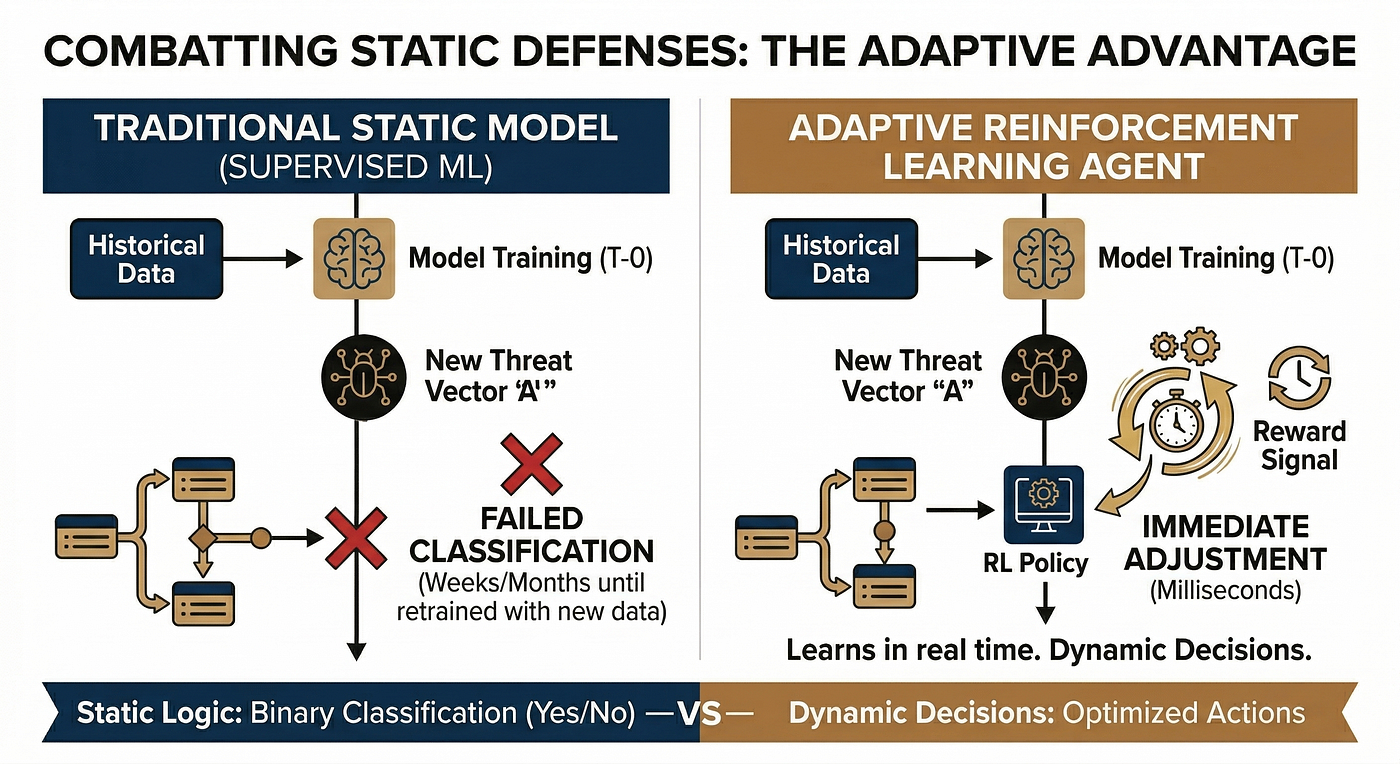
Most enterprise fraud systems are built on the same foundation: supervised machine learning trained on historical transactions, outputting a risk score, with a static business rule applied on top. If the score exceeds the threshold, block. If it falls below, approve.
This architecture has a structural flaw. It optimises for prediction accuracy, not business outcomes.
It does not know that 32% of customers never return to a merchant after a false decline (Riskified). It does not know that 65% of all declined transactions are legitimate orders being turned away (ClearSale). And when fraudsters shift tactics, the model's accuracy degrades silently, until a data scientist manually retrains it weeks or months later. By then, the damage is done.
This is concept drift. And it is not a bug in the model. It is structural to any supervised system built on historical labels.
The Binary Trap
Fraud detection is not a classification problem.
It is a decision problem.
There is a critical difference. A classifier asks: Is this transaction fraudulent? A decision system asks: Given everything I know, what action maximises long-term value?
Classifiers produce a risk score. Decision systems weigh the cost of a $50 chargeback against the lifetime value of a loyal customer. They understand that a step-up authentication prompt may be better than an outright block. They know that the optimal response for a first-time buyer in a new geography differs from that for a repeat customer with an unusual device signal.
Static thresholds can never make that trade-off. They can only classify.
The Cross-Border Multiplier
The stakes compound exponentially when transactions cross borders. Global cross-border payment flows reached $179 trillion in 2024, according to McKinsey's Global Payments Map. That volume, moving across fragmented regulatory standards, multiple settlement rails, and jurisdiction-specific compliance requirements, is precisely where sophisticated fraud concentrates.
AML fines alone reached a record high of more than $6 billion in 2023 (Fenergo, cited in McKinsey's 2024 Global Payments Report), a signal of how severely the industry is misjudging risk at the edges of its detection capability.
The 2016 Bangladesh Bank cyber heist illustrated the core vulnerability. Attackers exploited the SWIFT network not by bypassing a detection model, but by operating within the procedural and behavioural blind spots that static authentication systems were never designed to surface. The absence of dynamic, continuous behavioural monitoring was the critical weakness, a gap that a score-and-threshold approach cannot close.
In a multi-hop cross-border transaction, a static classifier is nearly useless. It cannot synthesise the context of a sender in one jurisdiction, a correspondent bank in a second, and a beneficiary in a third, all while running real-time compliance checks against fragmented sanctions lists. The environment is too dynamic. The adversary is too adaptive.
Fraud Adapts. Your Defence Should Too.
Synthetic identity fraud surged 311% between Q1 2024 and Q1 2025 (Sumsub). Account takeover attempts more than tripled year over year during peak transaction periods (Sift). New fraud vectors, business email compromise, social engineering at scale, and AI-assisted credential attacks appear continuously.
Fraudsters do not behave like data distributions. They probe defences, test transaction thresholds, and learn detection boundaries. They iterate faster than any retraining cycle can keep up with.
Static models will always lag. The data they trained on describes a fraud landscape that no longer exists.
The RL Opportunity: From Classification to Optimisation
This is precisely the environment where Reinforcement Learning excels.
Instead of predicting whether a transaction is fraudulent, an RL agent determines the optimal action to maximise long-term reward. The reward function is defined in business terms: minimise fraud losses, minimise customer friction, protect high-value customer relationships. The agent learns to calibrate its responses dynamically, step-up authentication, soft decline, manual review routing, and hard block, based on real-time feedback from live operational outcomes, not historical labels.
The results bear this out. Peer-reviewed research published in Scientific Reports (Nature, 2025) found that RL-optimised fraud detection systems reduced false-positive rates by 33% compared to baseline models on real financial transaction datasets. The same framework achieved a 19.7% improvement in fraud recall: catching more actual fraud while generating fewer false alarms.
These are not marginal improvements. When false declines are costing your enterprise nine times more than the fraud itself, a 33% reduction in false positives is a structural revenue recovery event.
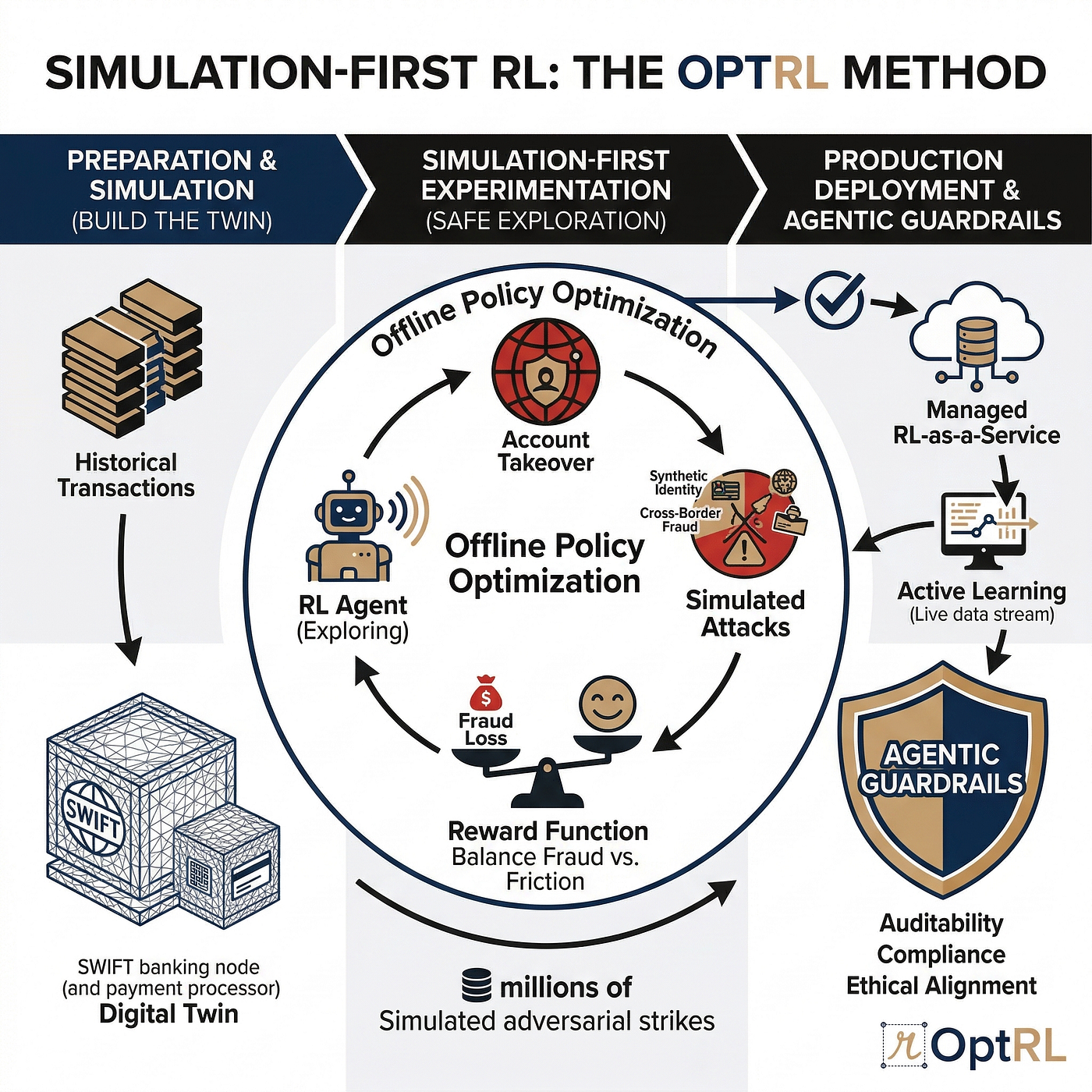
Safe Learning Before Live Deployment
Transitioning from static models to adaptive RL agents requires more than algorithmic intent. Enterprises cannot afford to let a system "explore" in production; an agent that experiments by allowing actual fraud through to learn a lesson is not a defence system.
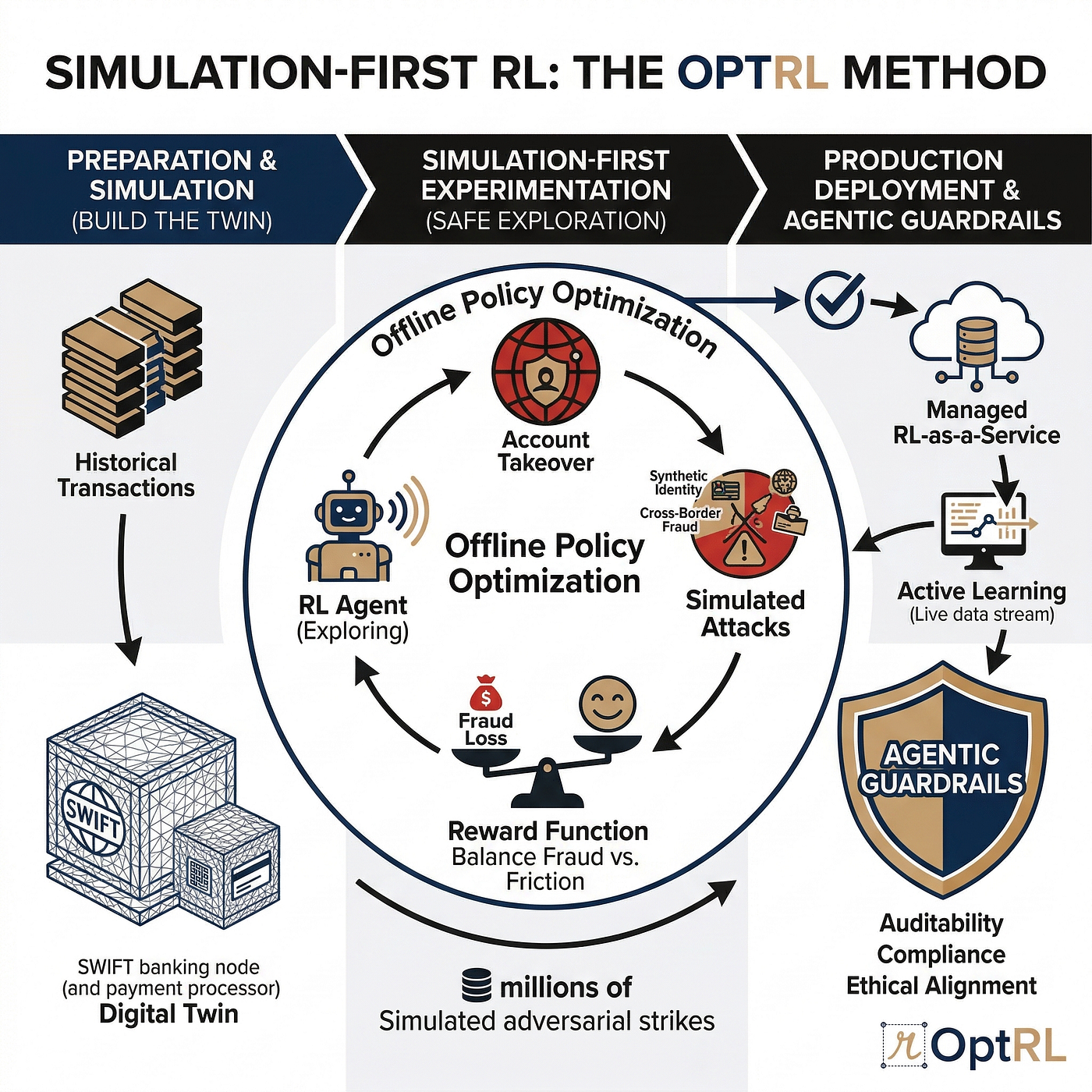
At OptRL, we solve this through Simulation-First Experimentation. Before a single policy touches live payment rails, we build high-fidelity digital twins of your transaction workflows, including cross-border messaging paths, compliance checkpoints, and adversarial attack scenarios. RL agents train against millions of simulated fraud patterns, including novel attack vectors and concept drift, before any production deployment.
Once live through our Managed RL-as-a-Service infrastructure, those policies continue to learn in production. Fresh feedback loops allow the system to adapt to new fraud patterns in real time without a manual retraining cycle. Agentic Guardrails ensure every decision remains auditable, explainable, and bounded by your enterprise risk appetite.
Static classifiers monitor. Adaptive agents optimise.
Evolve Your Defence
The fraud environment is not standing still. Fraudsters are deploying adaptive, automated tooling to probe enterprise defences at scale, and they are moving faster than supervised models can follow.
Every day a static threshold remains in production, it simultaneously overblocks legitimate customers and under-adapts to emerging threats. That combination, $443 billion in false decline losses and an adversary that learns faster than your retraining cycle, is exactly the problem adaptive RL is engineered to solve.
Connect with the OptRL team to see how Managed RL-as-a-Service transforms fraud detection from a classification exercise into a continuously optimising decision system.
References
- Nilson Report, Global Card Fraud Losses, January 2026
- Riskified / ClearSale, False Declines and eCommerce Fraud Prevention Report
- McKinsey & Company, Global Payments Map, 2024
- McKinsey & Company, Global Payments in 2024: Simpler Interfaces, Complex Reality, October 2024
- Fenergo, AML Enforcement Actions Surge in 2023 (cited in McKinsey Global Payments Report, 2024)
- Sumsub, Identity Fraud Report, 2025
- Sift, Digital Trust & Safety Index, 2024
- Scientific Reports (Nature), Reinforcement Learning with GNN Fusion for Real-Time Financial Fraud Detection, December 2025
References:
Written by
OptRL