Stop Throttling Your Edge Devices. Start Optimising with Adaptive RL Control.
Semiconductor companies are racing to pack more computing power into smaller devices, but thermal throttling is quietly costing performance, safety, and money. Here's how adaptive RL control fixes it.

Semiconductor companies are racing to pack more computing power into smaller devices. The Edge AI hardware market is projected to reach nearly $248 billion by 2035. But there is a problem that most people in the industry do not openly discuss: the smarter these devices get, the hotter they run. And heat is the enemy of performance.
Think of it like a sports car with a speed governor bolted on. You have a powerful engine under the bonnet, but the moment things get too warm, the car automatically slows itself down to avoid damage. That is exactly what is happening inside your edge AI hardware today.
The Real Problem: Your Hardware Is Throttling Itself
Modern edge devices, whether factory-floor cameras, smart traffic sensors, or telecom equipment, run powerful AI chips, including SoCs (System-on-Chip) and NPUs (Neural Processing Units). These chips generate a lot of heat when they are working hard.
To prevent overheating, the industry relies on a technique called DVFS (Dynamic Voltage and Frequency Scaling). In plain English: when the chip gets too hot, the system panics and turns down the clock speed, drastically reducing performance.
Real-world example: Imagine a security camera on a factory floor using AI to spot dangerous situations in real time. On a hot summer day, as the camera's chip heats up, the DVFS governor kicks in. The processor slows down. Frames get dropped. The AI misses a worker stepping into a hazard zone. That is not just lost performance. That is a safety failure caused by a thermal rule written in a spreadsheet years ago.
Research published in IEEE confirms this is not a rare edge case. Standard OS-based throttling governors can cause latency spikes of over 500%. That means your device can suddenly become five times slower, at the exact moment it needs to be fast.
Where This Is Hurting Businesses Right Now
This is not a niche technical issue. Thermal throttling is quietly causing failures across several of the fastest-growing industries.
1. Autonomous Manufacturing and Robotics
Factories are deploying AI-powered vision systems and robotic arms that make split-second decisions. When thermal throttling hits mid-shift, object detection latency spikes. A robotic arm misidentifies a component. A defective product slips through. On a high-volume line, even a few seconds of degraded performance can cost thousands of pounds. With static DVFS, engineers cannot proactively prevent this; they can only react after the slowdown occurs.
2. Smart Cities and Traffic Infrastructure
Edge AI nodes embedded in traffic lights, pedestrian crossings, and speed cameras run continuously in outdoor environments where ambient temperature can swing dramatically. A system that performs well at 10°C in January may throttle aggressively in July. Local authorities and operators are spending heavily on hardware upgrades and cooling enclosures, unaware that the root cause lies in a power management policy, not the hardware itself.
3. Telecom Edge and Open RAN
Telecom operators are pushing AI workloads out to the network edge to reduce latency. But base stations and edge nodes are thermally constrained environments. Unpredictable clock-speed drops in a radio access node result in call drops, buffering, and degraded service for end users. Network SLAs demand consistent, predictable performance. Thermal throttling makes that nearly impossible with static control policies.
4. Healthcare and Industrial IoT at the Edge
Wearable medical monitors, remote diagnostic tools, and industrial sensors are now running on-device AI inference to reduce cloud dependency. These devices have tiny batteries and tight thermal budgets. A single aggressive throttling event can interrupt a patient monitoring session or cause a sensor reading to be lost. Battery life is also deeply affected: static DVFS cannot adapt to the real-time trade-off between thermal headroom and energy budget.
Why Static Rules Cannot Solve a Dynamic Problem
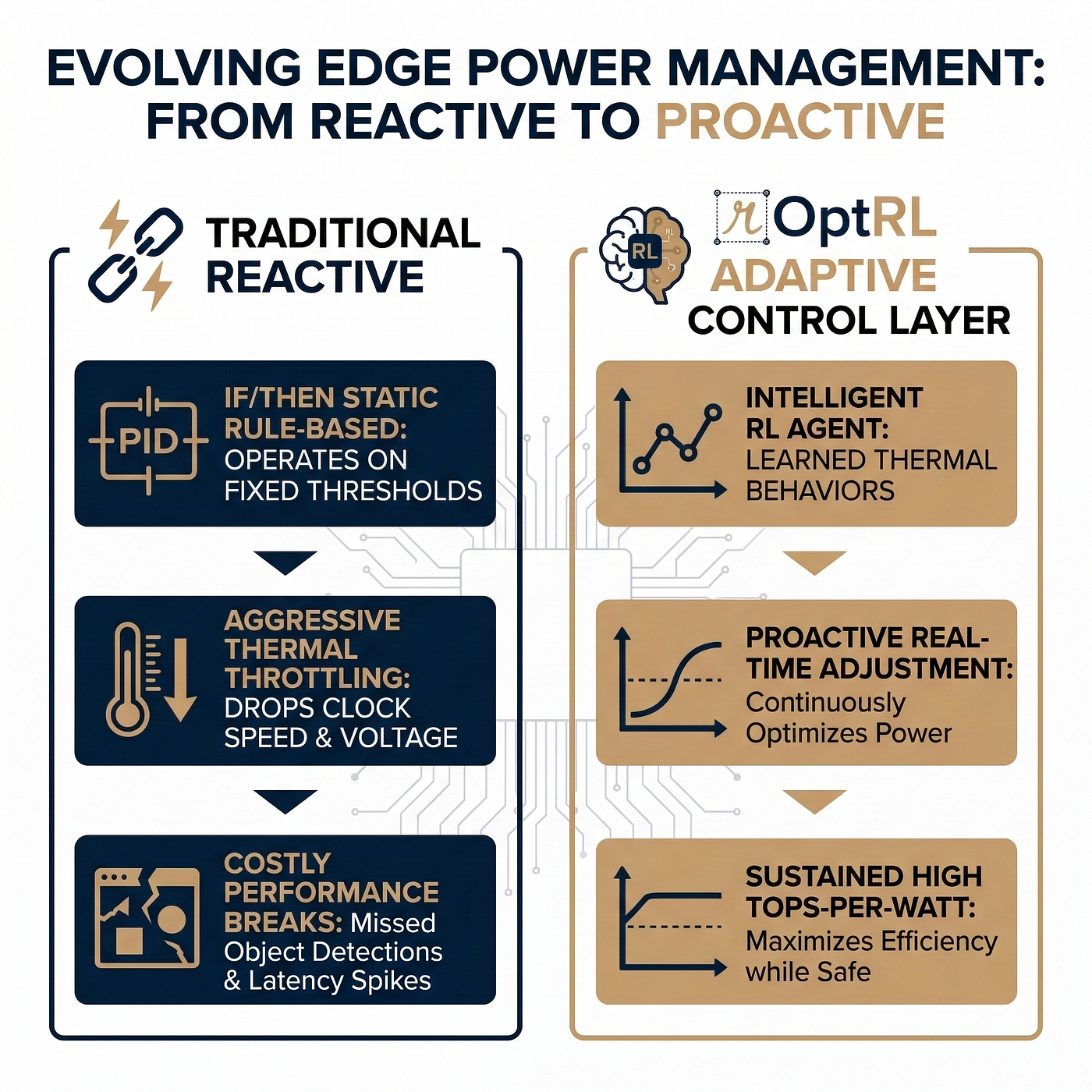
Here is the core issue. A traditional DVFS controller is essentially a thermostat with a single rule:
IF temperature > threshold, THEN slow down the chip.
That rule was written once, at the factory, and never changes. It has no awareness of what the next workload will be. It does not know whether you are about to process a burst of video frames or run a light background task. It cannot distinguish between a hot day and a faulty cooling fan. It simply reacts, bluntly and late, like a driver who only brakes after passing the speed limit sign.
The result is a system that constantly swings between underperforming (to stay safe) and overheating (because it waited too long). Neither state is acceptable for enterprise-grade edge AI.
A Better Way: Reinforcement Learning as an Adaptive Control Layer
This is where OptRL comes in. Instead of a fixed rule, we deploy an RL agent: a piece of software that learns to make better decisions over time, based on what actually happens on the device.
To go back to the car analogy: instead of a speed governor, you now have an experienced driver. They can feel the engine temperature, anticipate the upcoming hill, and smoothly adjust power before things go wrong. They do not wait for the car to overheat. They manage the situation proactively, moment to moment.
The RL agent does the same thing for your chip. It continuously monitors temperature, workload patterns, and voltage, and it adjusts clock speed proactively to:
- Maintain peak performance for as long as thermally possible
- Avoid the sudden performance cliffs caused by reactive throttling
- Adapt to the specific thermal characteristics of each individual device
- Maximise TOPS-per-watt, the industry's true measure of edge AI efficiency
IEEE research confirms that RL-integrated power management delivers 20% power savings compared to conventional DVFS, while maintaining better performance consistency. That is not a marginal gain. For a fleet of thousands of edge devices, that is a significant cost reduction and meaningfully longer hardware lifespan.
"But Won't a Learning AI Damage My Hardware?"
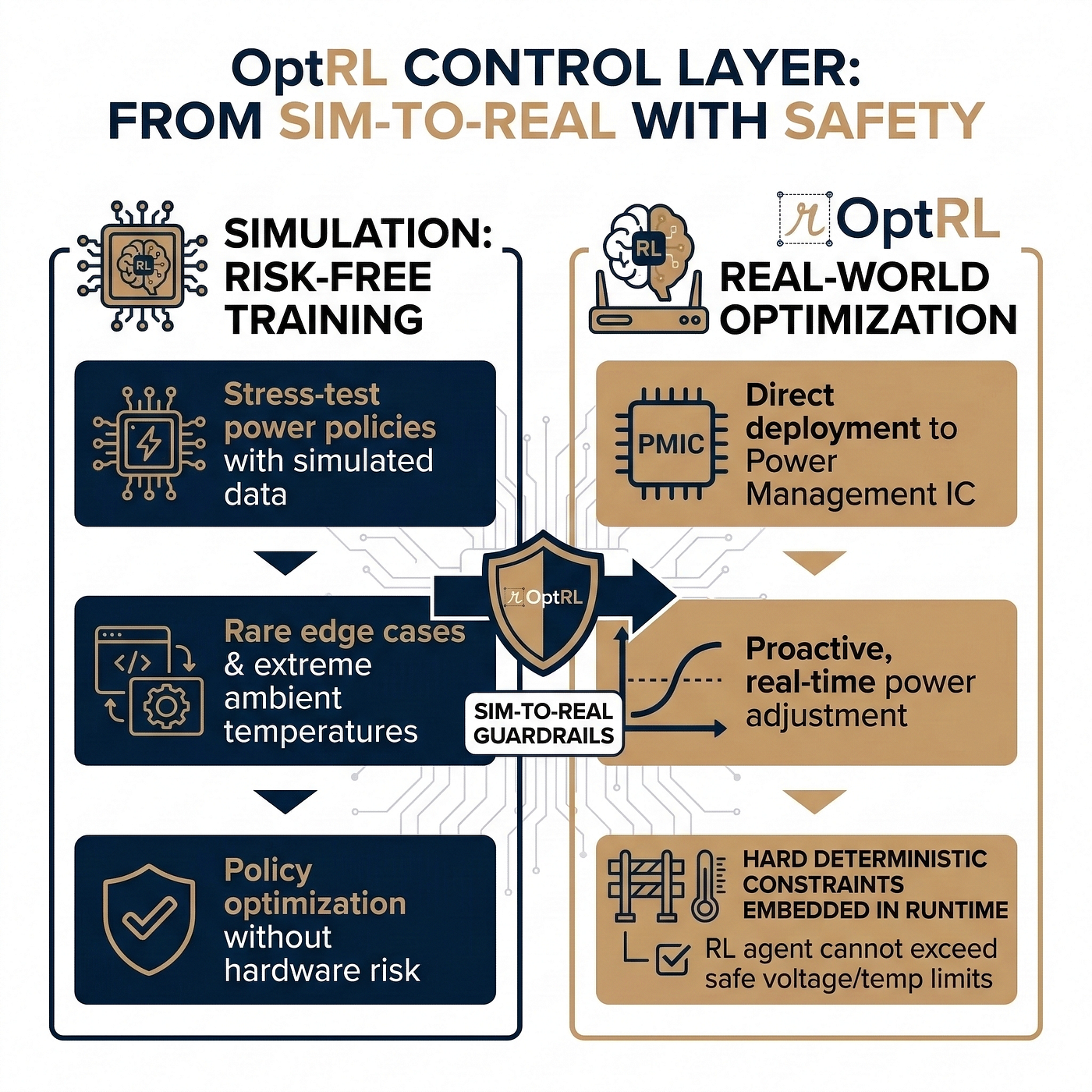
This is the first question every hardware engineer asks, and it is the right one to ask. Training an RL agent directly on physical silicon is too risky. An agent exploring its options on a live chip could easily push voltage or temperature into dangerous territory.
OptRL solves this in two ways.
First, simulation before deployment. We build a high-fidelity virtual replica of your chip and its environment. The RL agent trains entirely in software, including against rare worst-case scenarios: sudden workload spikes, extreme ambient heat, degraded cooling. Only once the agent has proven robust in simulation does it get deployed to real hardware. Think of it like a pilot spending thousands of hours in a flight simulator before ever touching the controls of a real aircraft.
Second, hard safety guardrails at runtime. Even after deployment, the RL agent operates inside deterministic boundaries defined by your hardware engineers. It cannot exceed the maximum safe voltage. It cannot breach the thermal ceiling. The agent is free to optimise intelligently within those bounds, but it cannot violate them. You get the adaptability of AI with the absolute safety guarantees of traditional engineering.
What This Means in Practice
Moving from static DVFS to OptRL's adaptive control layer has a measurable business impact:
- Consistent service levels. Eliminating unpredictable latency spikes means your SLAs become reliable, whether you are running a smart city node or a factory inspection system.
- Longer hardware lifespan. Reducing thermal stress extends the life of your silicon and solder joints, lowering replacement costs across large device fleets.
- Run bigger models on existing hardware. By unlocking performance headroom that static throttling was leaving on the table, you can deploy more capable AI models without buying new chips or expensive cooling enclosures.
- Reduced energy costs at scale. A 20% improvement in power efficiency, multiplied across thousands of edge nodes, adds up quickly on the energy bill.
Build Hardware That Adapts with OptRL
The bottleneck in edge computing is no longer raw processing power. It is how intelligently that power is managed. Static rules written for yesterday's chips cannot keep pace with the complex, variable real world in which your devices operate.
OptRL provides the end-to-end infrastructure to take your edge silicon from reactive to adaptive: simulation design, safe deployment, and ongoing managed RL-as-a-Service. You do not need a full technical specification to get started. Bring us your hardware constraints and the performance problem you are trying to solve.
Connect with OptRL today at optrl.com to schedule a discovery conversation and explore a practical, measurable pilot for your edge architecture.
References
References:
Written by
OptRL