Open RAN Needs a Brain
Open RAN delivered architectural flexibility and vendor diversity, but control alone does not equal optimisation. Why next-generation networks need a coordinated learning system, not a collection of independent optimisation apps.
1. The Problem: Open Architecture Without Intelligent Control
Open RAN has delivered what operators have demanded for years: architectural flexibility, vendor diversity, and interface-level standardisation. The traditional RAN black box has been opened. Control has been distributed. Visibility has improved.
But control alone does not equal optimisation.
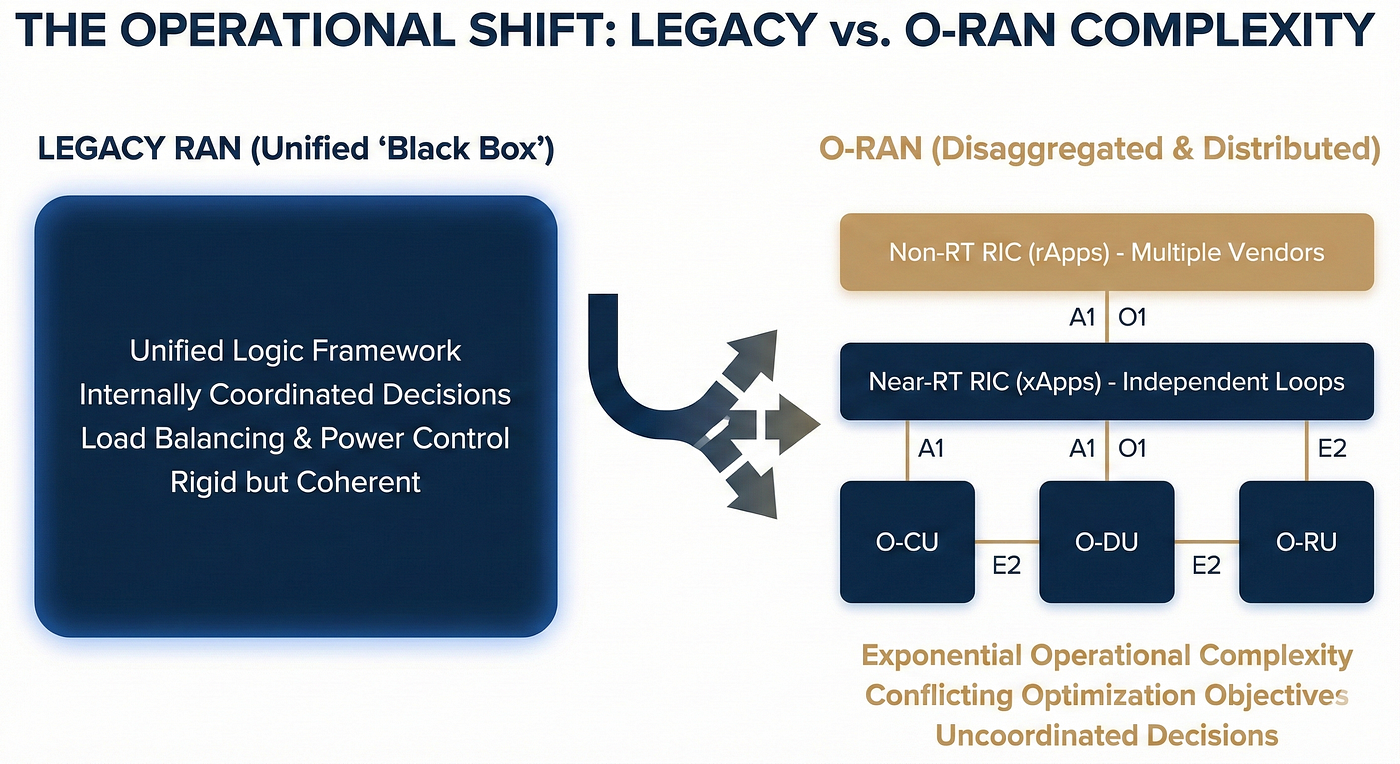
In legacy RAN systems, tightly integrated vendor stacks coordinated decisions internally. Load balancing, power control, mobility management, and interference mitigation operated within a unified logic framework. Those systems were rigid but internally coherent.
O-RAN changes that equation.
Disaggregation multiplies control variables. Multiple vendors introduce multiple optimisation objectives. Independent xApps and rApps introduce parallel control loops. Interfaces such as E2, O1, and A1 enable data exchange, but they do not guarantee coordinated decision-making.
The result is an exponential increase in operational complexity.
Traditional Self-Organising Network systems were designed for relatively stable 4G environments. They rely on static heuristics: when a threshold is crossed, an action is triggered. These systems react to conditions; they do not continuously evaluate trade-offs.
In the dense environment of next-generation networks, including 5G advanced and 6G, trade-offs are no longer linear. A mobility action that improves throughput in one cell may increase interference in a neighbouring cell. An energy-saving policy may conflict with an enterprise slice's SLA requirement. A congestion mitigation decision may temporarily solve load issues while degrading user experience elsewhere.
The core limitation is not telemetry. It is decision intelligence.
Rule-based systems cannot compute multi-objective trade-offs in real time. They cannot continuously optimise across energy efficiency, spectrum utilisation, quality of experience, and contractual SLA guarantees.
This becomes financially material.
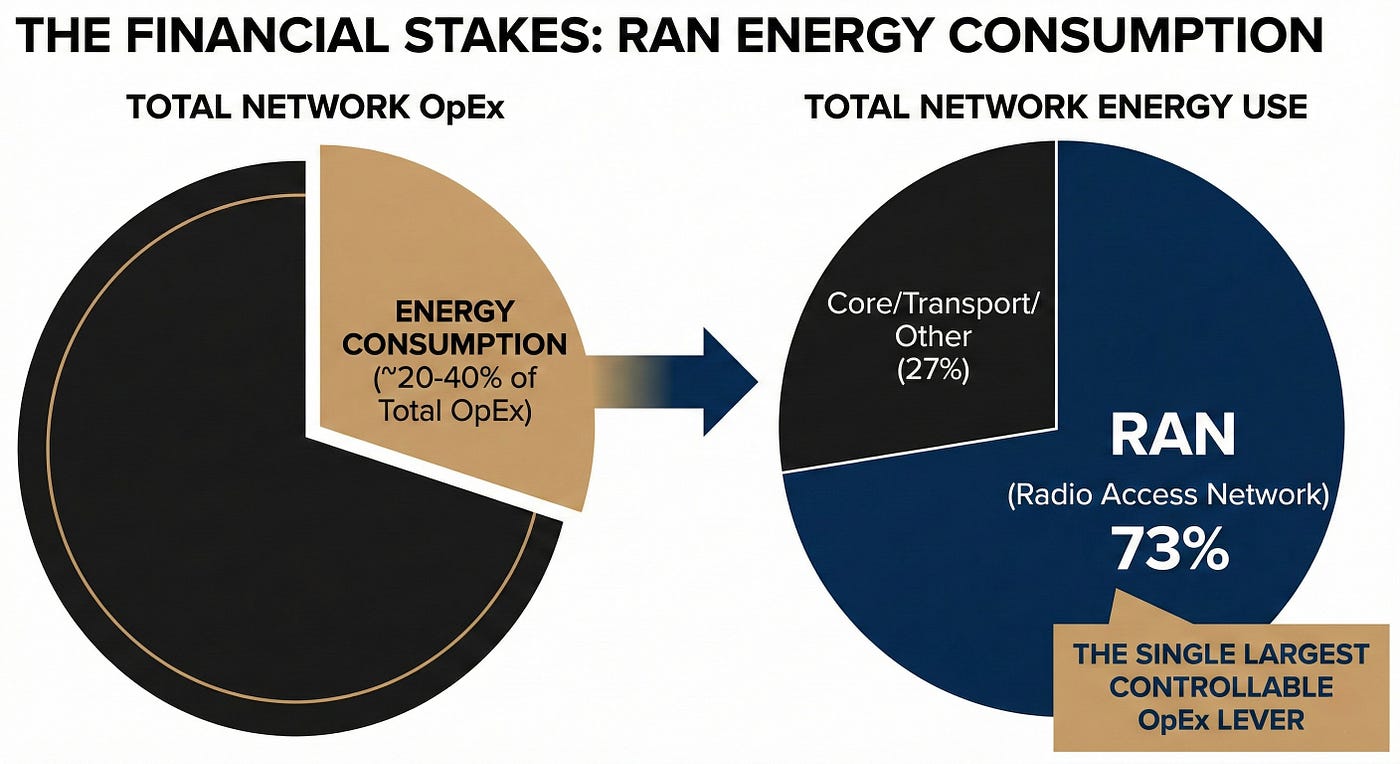
Energy consumption accounts for approximately 20% to 40% of total network operational expenditure. Within that, the Radio Access Network represents roughly 73% of total network energy use. The RAN is therefore the single largest controllable OpEx lever available to operators.
Without adaptive optimisation, inefficiencies accumulate quietly. Local optimisation can degrade global performance. Energy policies may conflict with slicing commitments. Throughput optimisation may increase interference costs. None of these necessarily trigger alarms, yet together they erode margin.
Many O-RAN deployments today are technically open but operationally under-optimised.
2. Industry Validation: The Scale of the Economic Pressure
This is not a theoretical concern. The financial pressure on RAN operations is well documented.
According to the GSMA, energy consumption accounts for approximately 20% to 40% of total network operational expenditure. Within that, the Radio Access Network accounts for roughly 73% of the overall network's energy usage. In practical terms, the RAN is the single largest controllable OpEx lever available to operators.
At the same time, sustainability mandates and carbon reduction targets are becoming board-level priorities. Operators are under simultaneous pressure to reduce cost, reduce emissions, and increase performance.
Industry trials have already demonstrated that AI-driven energy optimisation can reduce RAN energy consumption by measurable margins without degrading user experience. Major infrastructure vendors are publicly investing in AI-powered energy management frameworks. The direction is clear: optimisation is no longer optional; it is strategic.
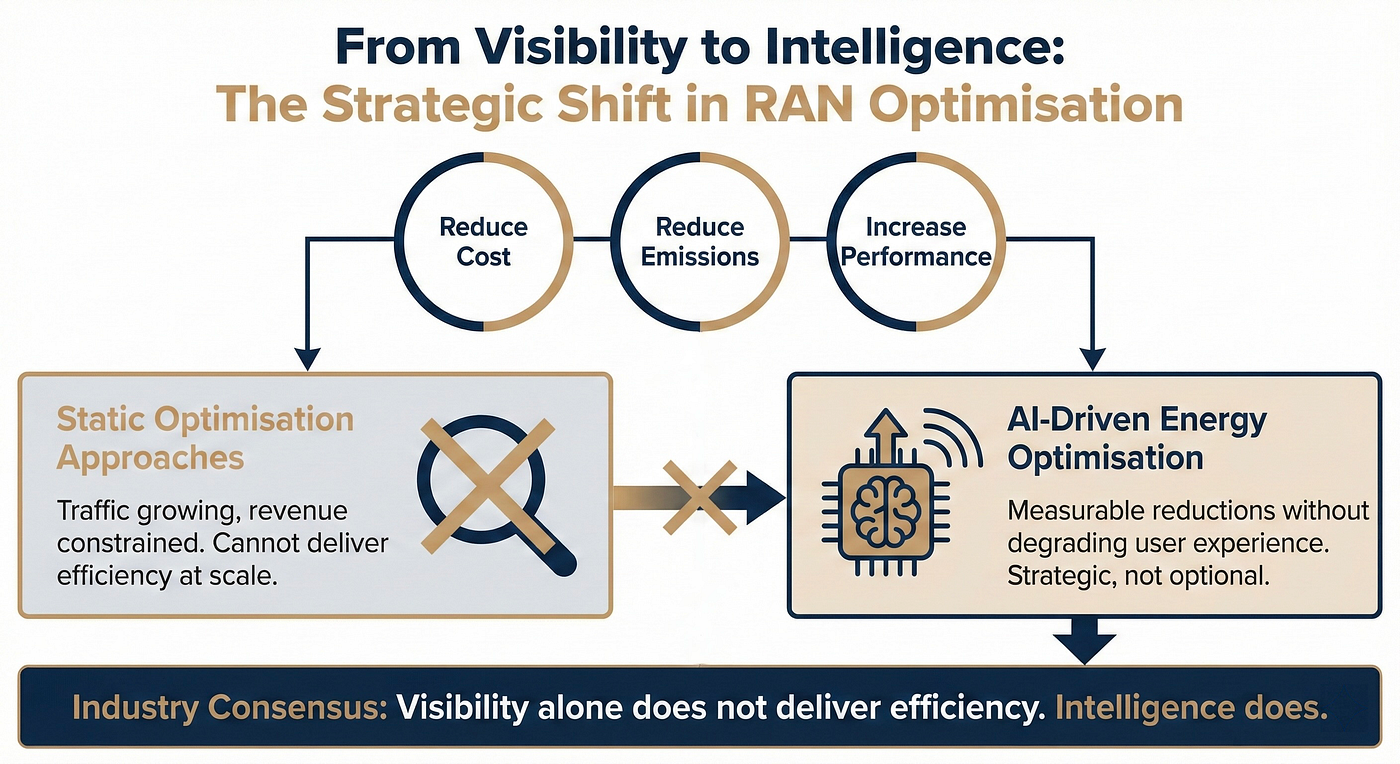
The GSMA's broader research on efficiency reinforces this trajectory. As traffic continues to grow while revenue per bit remains constrained, operators must extract more value from existing spectrum and infrastructure. Static optimisation approaches cannot deliver that efficiency at scale.
The industry consensus is emerging around one central theme: visibility alone does not deliver efficiency. Intelligence does.
3. The Next Five Years: From Open Networks to Autonomous Networks
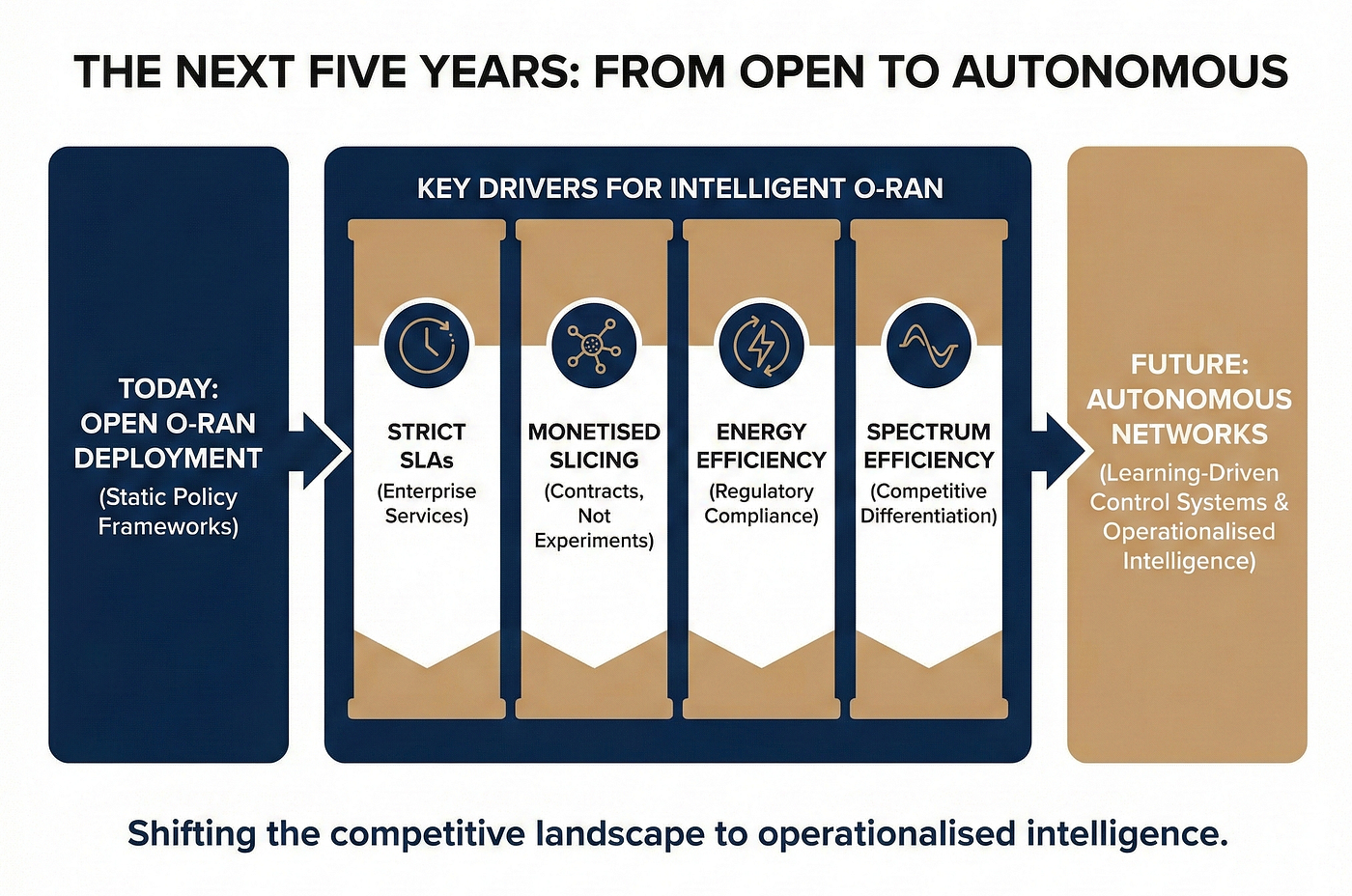
Over the next five years, the competitive landscape will shift from who has deployed O-RAN to who has operationalised intelligent O-RAN.
Enterprise services for next-generation networks are expected to drive new revenue streams, but these services come with strict SLA commitments. Network slicing will move from experimentation to monetised contracts. Energy efficiency will move from cost optimisation to regulatory compliance. Spectrum efficiency will determine competitive differentiation in saturated markets.
In this environment, networks built on static policy frameworks will face structural limitations. Operational conditions shift too quickly for manually engineered heuristics to remain optimal.
Simultaneously, discussions around global standards for 6G provide an important signal. Early IMT-2030 vision documents and industry roadmaps consistently emphasise native AI integration within network architecture. 6G research focuses not only on higher frequencies and capacity, but on embedding intelligence into radio, core, and edge systems.
This direction is architectural rather than speculative.
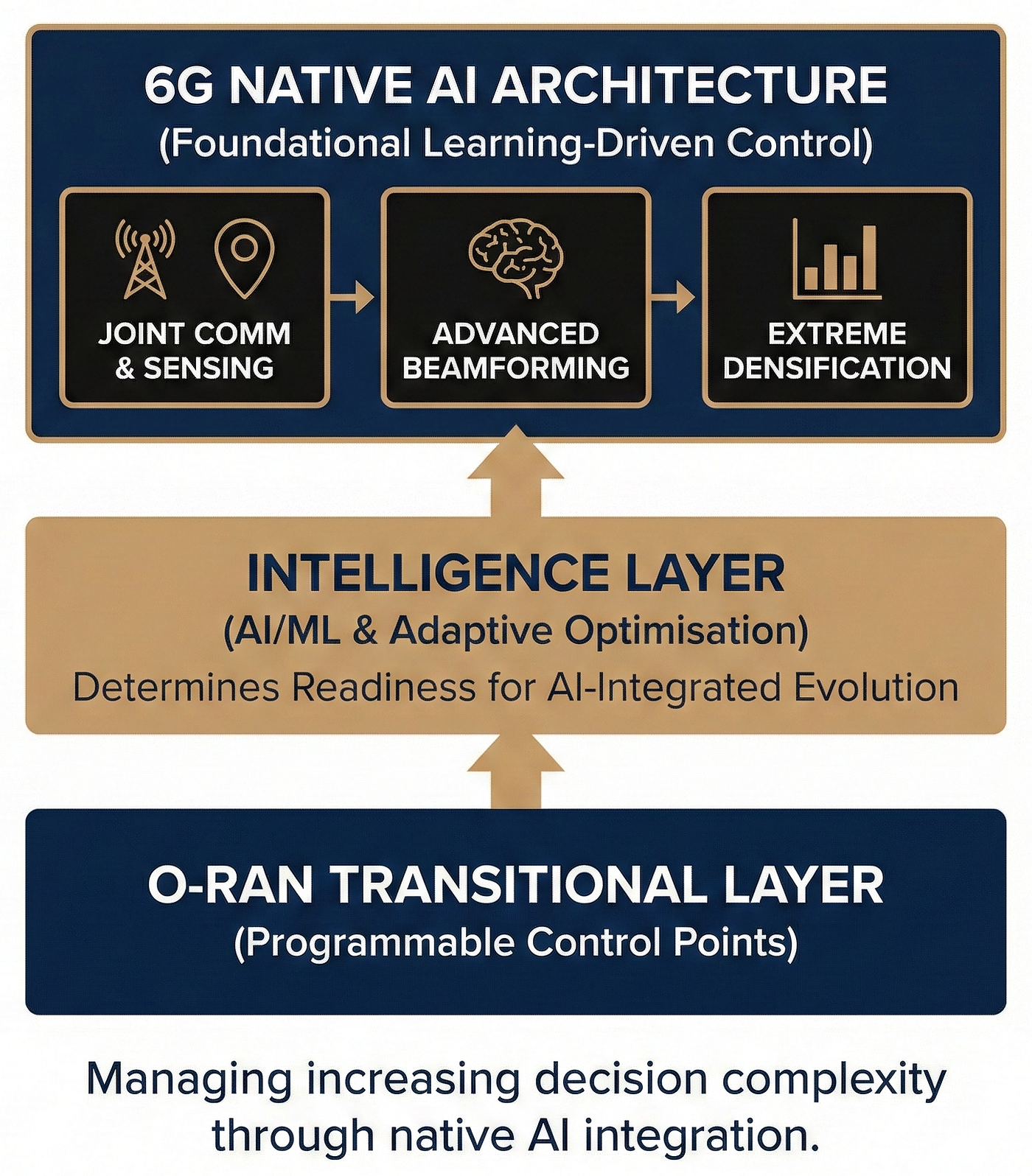
Joint communication and sensing, advanced beamforming in higher spectral bands, and extreme densification all increase decision complexity. Local rule-based optimisation becomes less reliable as interdependencies intensify. The industry's trajectory suggests that learning-driven control systems will be foundational rather than optional in next-generation networks.
O-RAN represents the transitional layer that exposes programmable control points. The intelligence layer built today will determine readiness for AI-integrated network evolution tomorrow.
The strategic question for operators is not whether adaptive optimisation will become necessary. It is how that intelligence will be implemented and governed at scale.
4. The OptRL Solution: Managed Intelligence for O-RAN
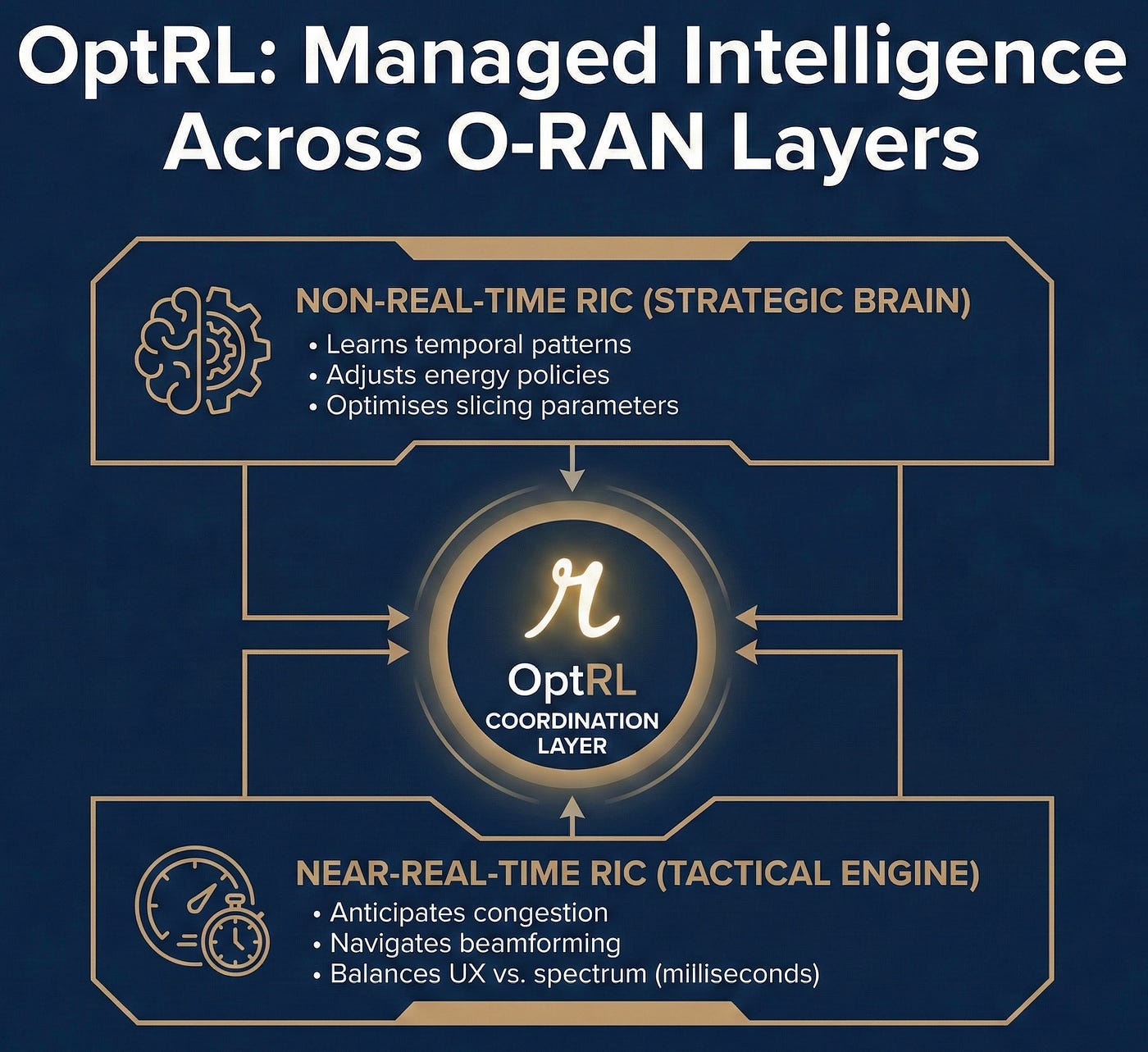
OptRL was built around a single principle: Open RAN requires a coordinated learning system, not a collection of independent optimisation apps.
Reinforcement Learning provides the foundation for that intelligence. Unlike rule-based systems, RL agents learn from interaction with the environment. They evaluate actions based on long-term reward, not immediate thresholds. They continuously adapt as traffic behaviour, interference patterns, and energy constraints evolve.
In the O-RAN architecture, this intelligence must operate across both strategic and tactical layers.
At the Non-Real-Time RIC level, RL agents act as the strategic brain. They learn temporal traffic patterns, dynamically adjust energy policies, and optimise slicing parameters to maintain SLA adherence without over-provisioning resources. Instead of static sleep schedules or fixed slice partitions, policies evolve continuously based on observed outcomes.
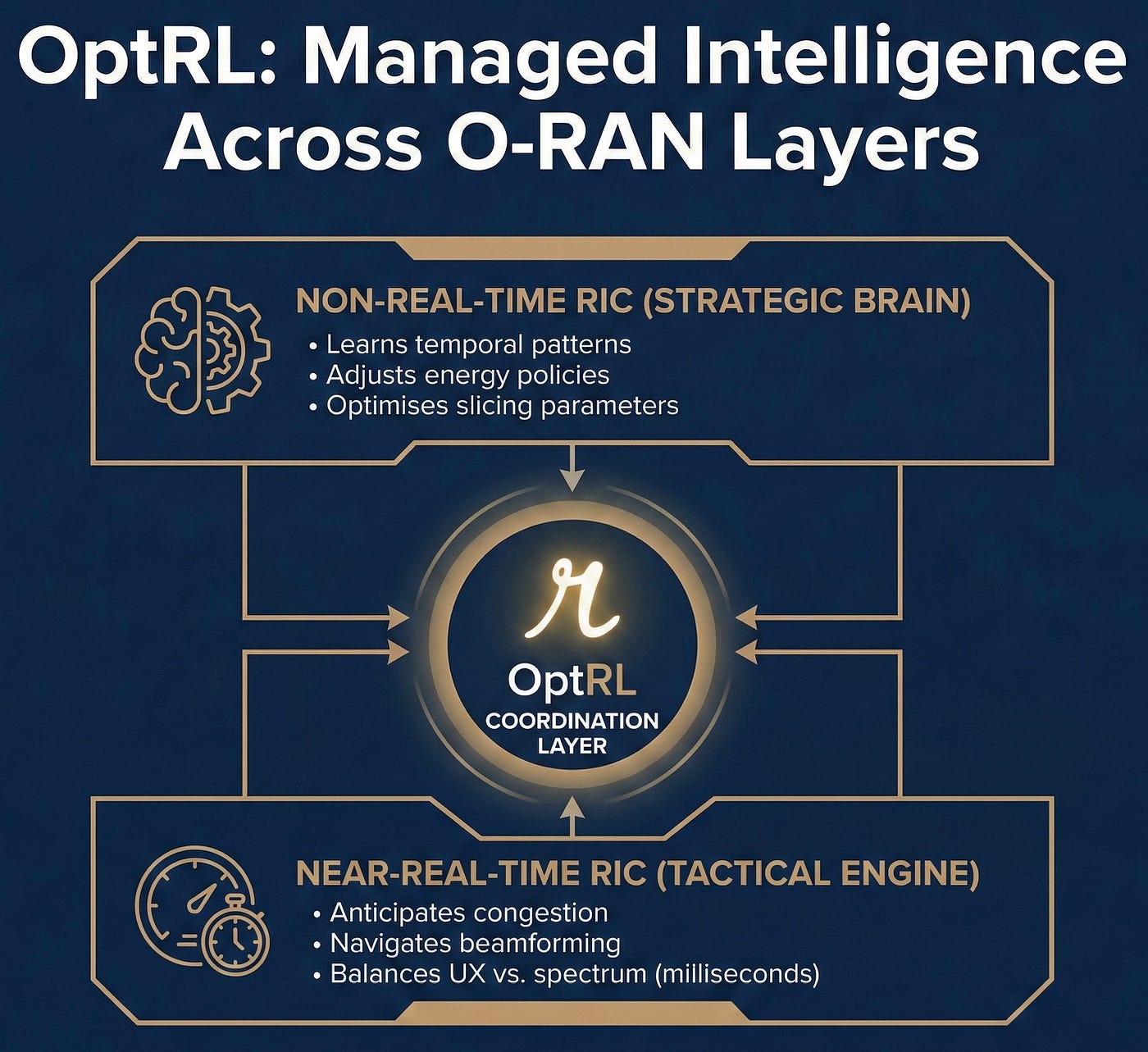
At the Near-Real-Time RIC level, RL agents operate within tight latency budgets. They anticipate congestion before thresholds are breached. They navigate complex beamforming decision spaces to maximise signal quality. They balance user experience against spectrum efficiency in milliseconds.
The key is coordination.
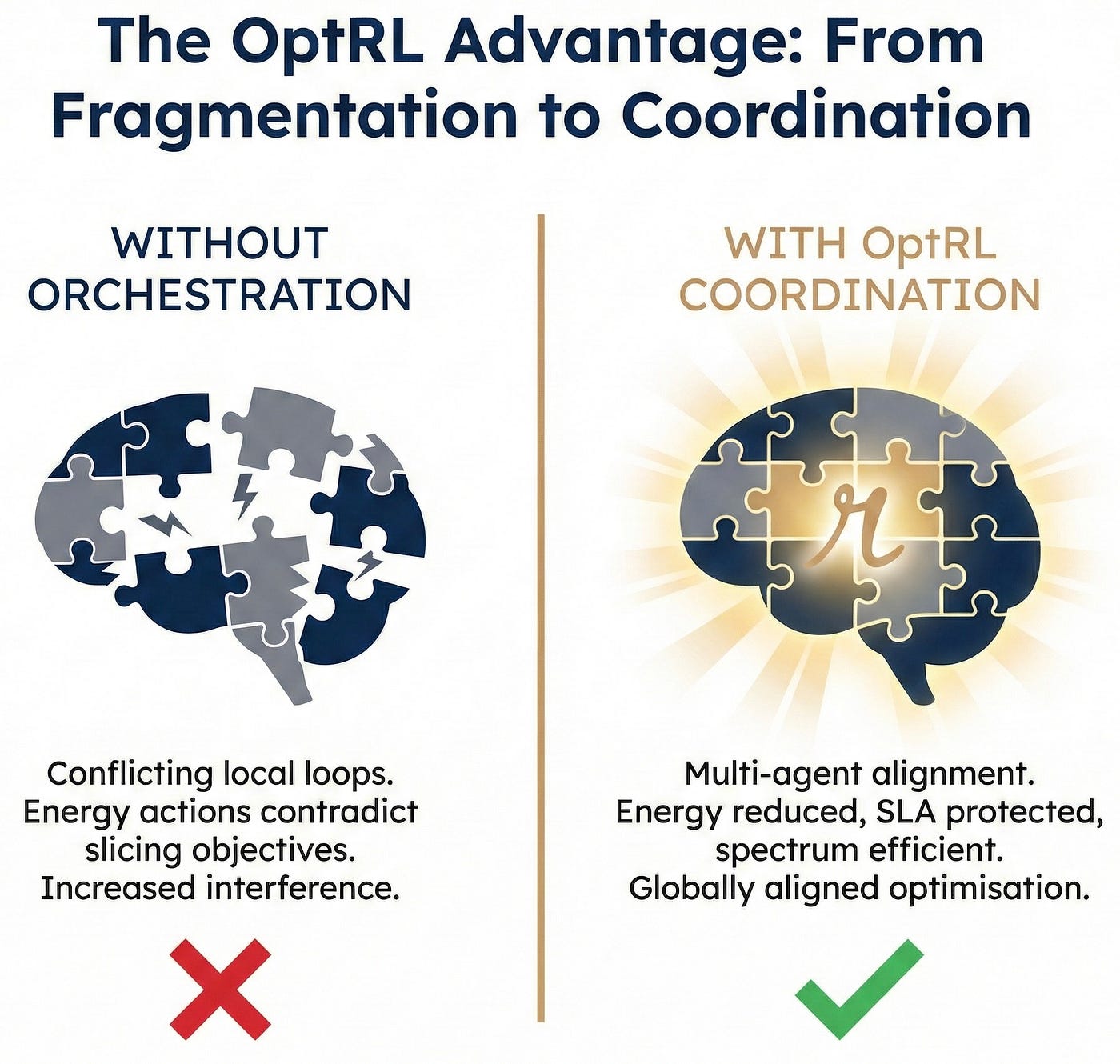
Without orchestration, local learning loops can conflict with one another. An energy-saving action may contradict a slicing objective. A throughput optimisation may increase neighbouring interference. OptRL manages multi-agent coordination across rApps and xApps, ensuring that optimisation remains globally aligned rather than locally fragmented.
We provide RL-as-a-Service purpose-built for telecom environments. That includes model lifecycle management, convergence stability, policy governance, and continuous deployment within production-grade pipelines. Operators do not need to build an internal AI research division to achieve autonomous optimisation. They inherit a managed cognitive layer integrated into their O-RAN stack.
The result is not simply automation. It is continuous optimisation.
Energy consumption is reduced without compromising the quality of experience. Spectrum is utilised more efficiently. SLA commitments are protected. Network behaviour adapts dynamically rather than reactively.
Open RAN delivered architectural freedom. OptRL delivers operational intelligence.
The next phase of competitive advantage in telecom will not come from openness alone. It will come from networks that can think, learn, and optimise in real time.
Open RAN needs a brain.
References:
Written by
OptRL