The Age of Autonomy: Why the Future of Enterprise is Action, Not Just Analysis
We have built systems that can explain the world with terrifying accuracy. Now, we need systems that can actually change it.
We have built systems that can explain the world with terrifying accuracy. Now, we need systems that can actually change it.
Technology has reached a strange paradox. We possess tools that can forecast quarterly sales trends with precision, flag compliance risks across thousands of contracts, or automate diverse customer support interactions. We have built the ultimate observers.
But business is not a spectator sport.
If you ask these same systems to rebalance a global inventory across five distribution centres during a supply chain disruption, or to dynamically hedge a portfolio in response to a sudden rate hike, they freeze. They can tell you what might happen. The predictive decision has been made, but the adaptive action has yet to be executed.
The next frontier of enterprise isn't about predicting the next data point; it's about executing the best action.
The Gap Between Prediction and Performance
To understand why current predictive models aren't the final solution for enterprise operations, we need to examine their fundamental design. They are trained to analyse sequences based on static datasets. They are brilliant at retrieval and synthesis, but they are fundamentally passive.
However, business is not a content generation task. Business is a continuous loop of decision, action, and consequence.
A standard predictive model reads a logistics report and states: "There is a high probability of a stockout in the APAC region."
An Autonomous Agent observes the data, assesses holding costs at regional warehouses, calculates the trade-off between expedited shipping and lost revenue, and executes the transfer order to prevent the shortfall.
This is the difference between passive analysis and active management. This is the domain of Reinforcement Learning (RL).
From Static Automation to Dynamic Autonomy
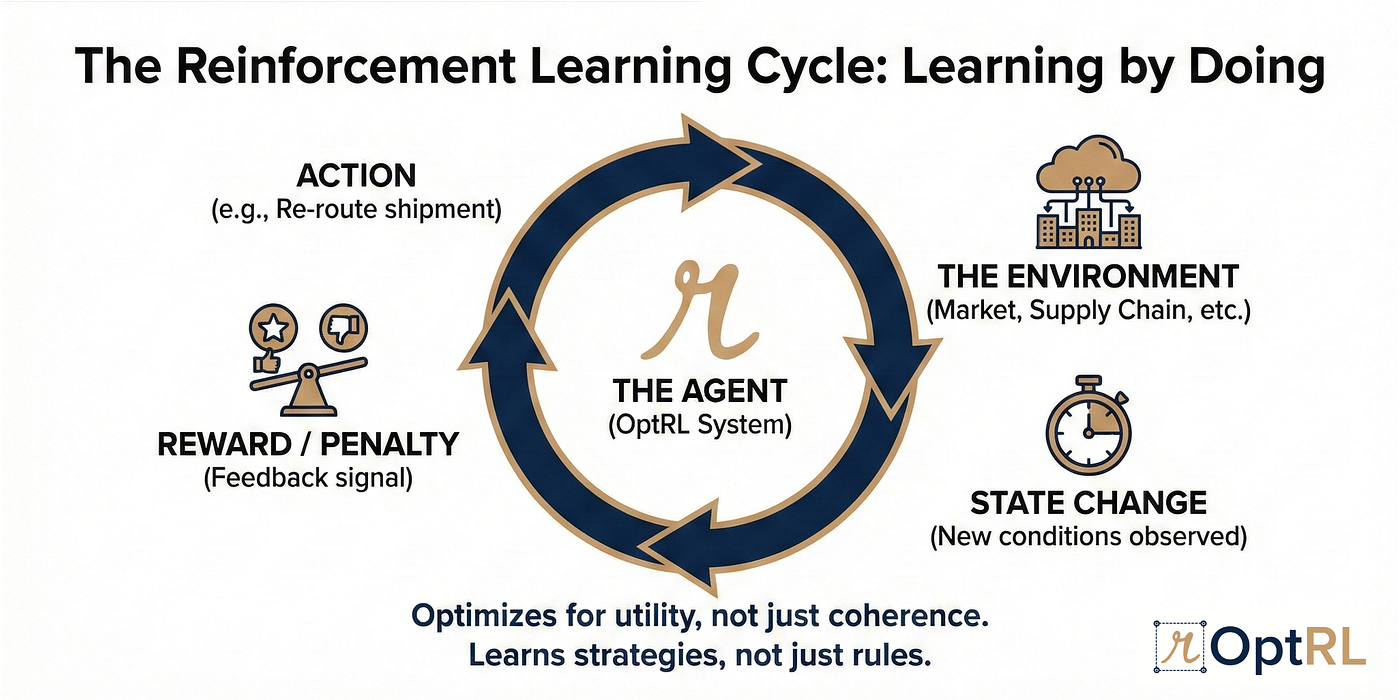
At OptRL, we view the world through the lens of agency. Unlike supervised learning (which learns from historical labels) or unsupervised learning (which finds hidden patterns), Reinforcement Learning is about learning through interaction.
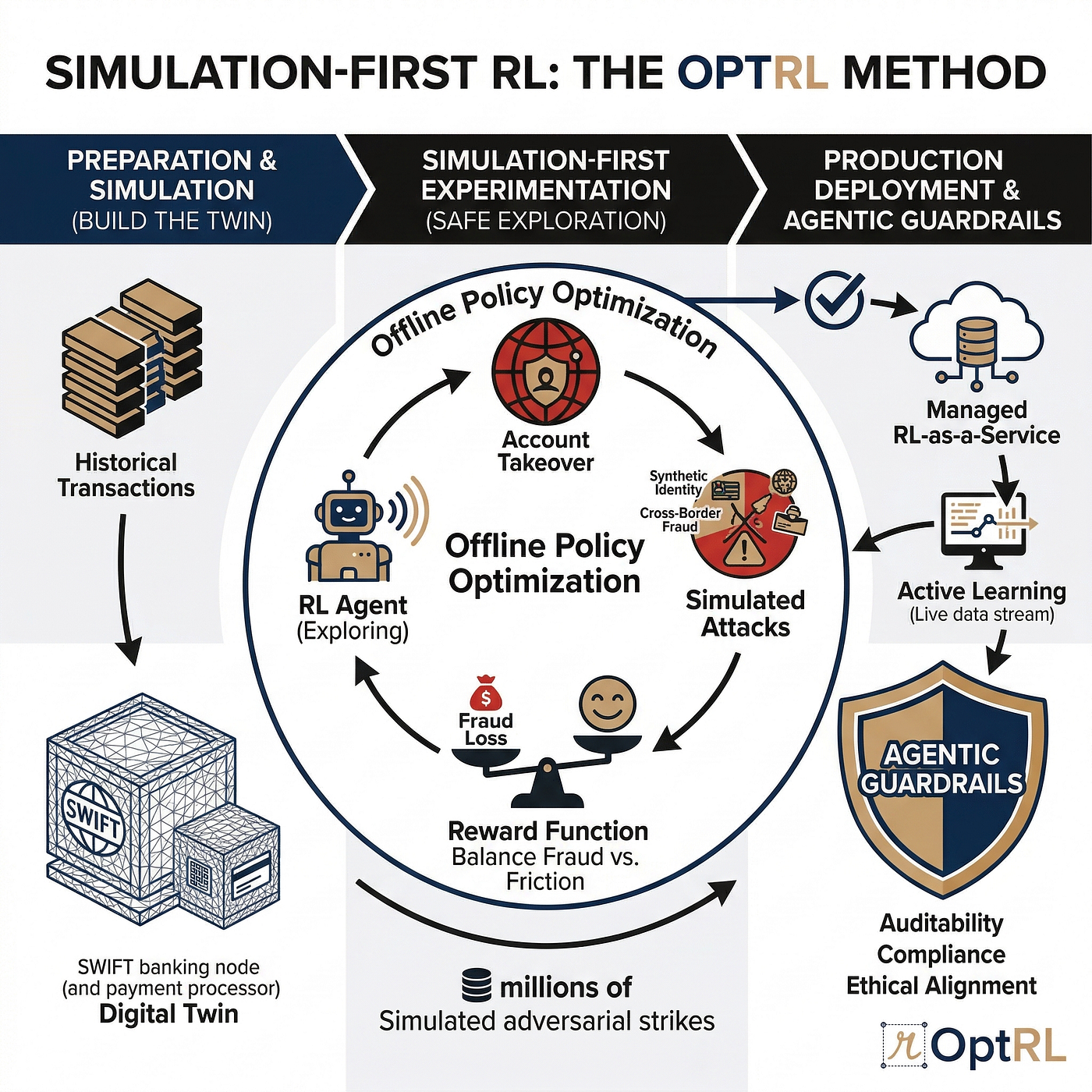
In an RL framework, an "agent" exists within an environment. It takes an action, observes the result, and receives feedback. Over millions of simulations trained on a digital twin of your supply chain or energy grid, the agent learns not just to follow a rulebook, but to develop complex strategies that maximise long-term utility.
This distinction is profound: Automation is following a script faster than a human can. Autonomy is writing the script in real-time.
Consider a modern logistics network. It is a chaotic, stochastic environment filled with uncertainty. A rule-based system ("If inventory < 100, buy 50") fails the moment a supplier goes on strike or a shipping route closes. A standard analytical model might offer advice, but it cannot be trusted to pull the trigger.
An RL agent, however, learns to balance conflicting goals, like minimising storage costs while maximising delivery speed, and adapts instantly when the parameters change. Whether it is optimising energy grids to balance load and reduce carbon footprints, or deploying trading agents that navigate volatile markets without human hand-holding, the goal is active, reliable execution.
The Road Ahead
The hype around recent tech trends will eventually settle. When the dust clears, enterprises will be left with a single, critical question: "We have all this intelligence, but how do we apply it?"
The answer lies in combining semantic understanding with RL's strategic decision-making. The next generation of technology will be defined by its ability to navigate uncertain environments and make complex decisions on your behalf. It won't just tell you what to do; it will handle it for you.
That is the future we are building at OptRL.
References:
Written by
OptRL